Nonprofit Operations Systems: How to Increase Capacity Without Adding More Chaos
Nonprofit leaders rarely hit a capacity ceiling because they care too little, work too slowly, or need to squeeze more effort out of their teams. They hit it when programs, stakeholders, reporting, fundraising, and delivery start moving faster than the systems holding everything together.
Suddenly one more spreadsheet, one more meeting, one more heroic team member becomes the norm. From the outside it looks like passion. From the inside? It feels like quicksand.
That's why nonprofit operations systems aren't optional back-office tools - they are the invisible infrastructure that protects your mission, your team, and your sanity.
The smartest shift you can make right now: stop asking "How do we do more?" and start asking "What systems let us do more without breaking the people doing the work?"
Why More Activity Doesn't Automatically Create More Capacity
Capacity isn't motion - it's flow.
You can have back-to-back meetings, growing programs, and an exhausted team and still be severely under-capacity. More effort without better systems just hides the friction and turns good people into professional fighters.
Real capacity shows up when work moves forward with less rework, fewer escalations, shorter waiting periods, and way less heroics.
What Nonprofit Operations Systems Actually Do
They turn chaos into repeatable clarity.
Strong systems quietly answer the questions that drain energy every single day:
- What happens first, next, and last?
- Who owns what?
- What needs approval vs. what can move?
- Where do handoffs happen?
- What does "done" actually look like?
When those answers are clear, you get reliability - the secret ingredient that lets mission-driven teams scale without burning out. This is the heart of: Operational Excellence: Protect Margins & Scale Without Chaos in $1M+ Service Businesses & Nonprofits building infrastructure that supports the mission instead of draining the people carrying it.
The Biggest Signs You Have a Systems Problem, Not Just a Workload Problem
You are likely dealing with a systems issue if:
1. Everything Important Still Routes Through Leadership
If staff need constant executive interpretation, approval, or rescue, capacity is capped no matter how dedicated the team is. It is often a sign that ownership rules, escalation paths, and decision criteria have not been defined clearly enough.
2. Work Gets Repeated, Clarified, or Corrected Too Often
When information gets lost between departments, donor communications are inconsistent, or program tasks keep getting redone, the cost is bigger than time. It erodes confidence and creates avoidable stress.
3. Teams Are Busy but Priorities Still Feel Fuzzy
If every request feels urgent, your organization is not managing flow well. It is reacting. Without clear operating rules, teams default to noise, not priorities.
4. Reporting Takes Too Long to Build
When leaders need to pull updates manually from multiple people or tools, visibility is too fragile. That means decisions get delayed or made from partial information.
5. Knowledge Lives in a Few Reliable People
If key processes only work when certain people are available, the organization is more dependent than it should be. That creates risk, slows onboarding, and makes growth far more chaotic than it needs to be.
If these sound familiar, you don't need another motivational push. You need clearer operating rules.
The Core Nonprofit Operations Systems That Increase Capacity
You don't need a massive transformation project to improve capacity. You need the right core systems strengthened in the right order.
1. Decision-Making & Approval Flow. Stop letting every decision float up to the top. Define what can be decided where and free leadership time for real leadership work.
2. Program & Service Delivery Workflows. Standardize the path from intake to impact. Remove the guesswork so your team can focus on quality instead of coordination drama.
3. Team Handoffs & Ownership Clarity. Most friction lives in the “between.” Make handoffs explicit so nothing falls through the cracks.
4. KPI Visibility & Operational Dashboards. Simple, useful views of delivery volume, bottlenecks, and capacity risks - so you catch problems while they’re still small.
5. Documentation & Repeatable Process Standards. Make recurring work easier instead of reinventing the wheel every quarter.
For a related look at what happens when scale outpaces structure, review How to Scale a Nonprofit: From Chaos to a Multi-Million Roadmap and How to Scale Without Burnout: The Systems Every Leader Needs Before Hiring More Staff.
How to Strengthen Capacity Without Overwhelming Your Team
Don’t turn “fixing systems” into another massive project. Start small and smart.
Simplify before you add. Cut unnecessary steps, redundant approvals, and duplicated effort first.
Spot hidden bottlenecks. Follow the actual work. Look for recurring delays, single points of dependency, and places where momentum dies.
A Practical Nonprofit Operations Audit to Run This Quarter
Pick one high-stakes workflow (grant reporting, program onboarding, donor stewardship, etc.) and ask:
- Is the starting trigger clear?
- Where do approvals happen, and are they necessary?
- Where do handoffs slow down or break?
- What information is hard to find when needed?
- What one recurring issue keeps causing rework?
One clear fix from this exercise often creates more breathing room than adding headcount.
Next Steps for Leaders Who Need Real Operational Clarity
Sustainable growth doesn’t come from bigger teams first - it comes from clearer systems that support the teams you already have.
If your nonprofit feels stretched thin and you’re tired of bandaids, it’s time to look at the systems behind the work.
Ready to find out exactly where your delivery flow is breaking and what to fix first?
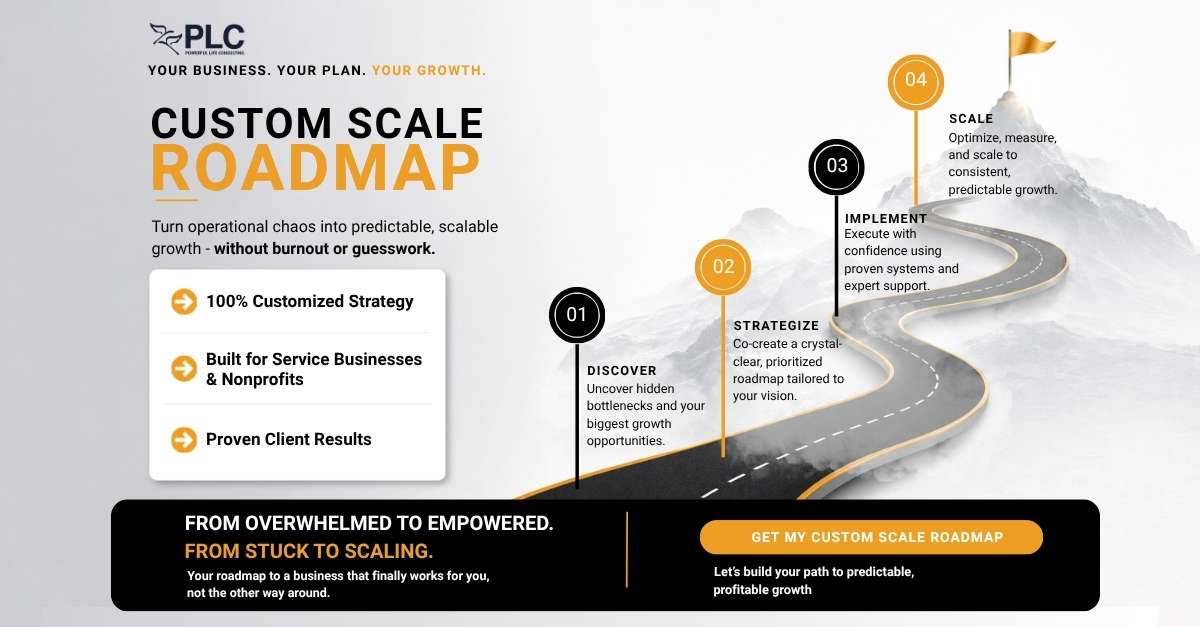
Claim your Custom Scale Roadmap to get clarity on your biggest capacity blockers and the highest-leverage moves to fix them - fast.