
3 Patterns Behind a Service Business Growth Ceiling and How to Break Through It
Growth can look healthy on paper while the business becomes heavier to run.
Revenue is moving. The pipeline is active. Clients are asking for more. Yet every new project creates more pressure on the founder, the team, or the delivery engine. Decisions slow down, margins tighten, and the business starts depending on heroic effort to keep ordinary promises.
That is often a service business growth ceiling in the making.
It is not necessarily a motivation problem. It is not always a sales problem. And the answer is not automatically another hire, another tool, or another push for demand. At PLC, we see the ceiling show up first as a small set of repeatable patterns inside the business.
This article breaks down the three I watch most closely:
- Important decisions still route through the founder.
- Delivery capacity has not caught up with demand.
- The team is managing from lagging results instead of leading indicators.
For each pattern, you will see what it looks like, what it quietly costs, and the first corrective move to make before adding more complexity.
What a Service Business Growth Ceiling Looks Like Before Growth Stops
A growth ceiling rarely arrives as one dramatic event. More often, it feels like the business is running uphill through sand.
You can still win clients, but the work takes more coordination than it used to. You can still hit revenue targets, but the margin left after rework and over-servicing keeps shrinking. You can still rely on a talented team, but too many questions, exceptions, and last-minute decisions keep landing in the same place.
Common early signs include:
- The founder is the final approver for work the team should be able to move independently.
- New demand creates delivery strain before it creates usable profit.
- Client promises depend on who remembers what, rather than what the operating system makes visible.
- Problems appear in missed deadlines, client complaints, or cash pressure instead of earlier warning signals.
- The team is busy, but leaders cannot clearly explain which constraint is limiting the next stage of growth.
The important distinction is this: a ceiling is usually structural before it is motivational. When capable people keep encountering the same friction, look at the decision flow, capacity rules, handoffs, and visibility before assuming people simply need to try harder.
Pattern 1: Every Important Decision Still Routes Through the Founder
The founder may say the team is empowered. The calendar may say otherwise.
Signals: Approvals, Escalations, and Client Promises Collect at the Top
Watch for these signals:
- Team members wait for permission to resolve routine client or delivery questions.
- The founder reviews work that already has a capable owner.
- A client receives an answer only after someone checks with the person at the top.
- Priorities change in meetings because the real decision rights were never clear.
- The founder's absence creates a queue of “quick questions” that is anything but quick.
This pattern can hide behind a reputation for high standards. Quality matters. So does consistency. But when the founder becomes the routing layer for every meaningful choice, leadership time gets consumed by decisions that should have been designed into the system.
Hidden Cost: The Business Cannot Move at the Speed of Demand
Founder dependency slows decision speed, trains the team to escalate, and makes growth feel personal rather than repeatable. It also creates a dangerous illusion: the founder may believe the team is not ready, while the team has never been given clear boundaries within which to act.
The cost shows up as delayed work, interrupted strategic thinking, and clients who experience the business as less responsive than its sales promise suggests.
First Fix: Clarify Decision Rights and Escalation Rules
Do not begin with a broad instruction to “take more ownership.” Make ownership specific.
For recurring decisions, define:
- Who owns the decision.
- What they can decide without approval.
- Which conditions require escalation.
- How the decision will be recorded so the same question does not return next week.
Start with the 5 decisions that interrupt the founder most often. Give each one a clear owner, a boundary, and an escalation path. Then measure how many of those decisions still come back to the founder after the change.
Pattern 2: Delivery Capacity Has Not Caught Up With Demand
More demand is not the same as more capacity.
Signals: Over-Servicing, Rework, Rushed Handoffs, and Margin Pressure
This pattern often appears when the business keeps selling the outcome but has not defined the delivery conditions required to produce it well.
You may see:
- Projects starting before the right people, information, or time are available.
- Team members absorbing “small extras” that quietly change the scope.
- Handoffs arriving late, incomplete, or without a clear owner.
- Rework becoming normal because the first version was rushed.
- Delivery leaders using personal effort to protect client experience.
- The business adding volume while margin and team energy move in the opposite direction.
The danger is that a service business can look successful while its delivery model is quietly borrowing from the future.
Hidden Cost: Growth Creates More Work, Not More Usable Profit
When capacity rules are unclear, the business responds to demand with improvisation. The team stretches. The founder steps back into delivery. Client promises expand because no one has a shared view of what the system can absorb.
Eventually, the business pays for the same work more than once: once in the original delivery, again in revisions, and again in the leadership time required to repair the handoff.
First Fix: Install Capacity Guardrails Before Adding More Volume
Create a simple capacity view that answers four questions every week:
- What work is committed?
- What capacity is actually available?
- Where is the next handoff likely to break?
- Which requests need to be scoped, sequenced, or declined?
Then establish guardrails around work in progress, response times, change requests, and the conditions required before a project starts. These rules are not there to make the business rigid. They protect the quality and margin that growth is supposed to create.
Measure delivery hours against plan, rework, late handoffs, scope changes, and margin pressure. You do not need a giant dashboard. You need enough visibility to see when demand is outrunning the system.
Pattern 3: The Team Is Managing From Lagging Results Instead of Leading Indicators
If the first time you know there is a problem is when revenue, deadlines, or morale have already taken a hit, the business is managing too late.
Signals: Problems Become Visible Only After the Damage Is Done
Look for these signs:
- Weekly meetings recap what happened but do not surface what is about to happen.
- Leaders rely on end-of-month results to explain problems that started weeks earlier.
- Everyone reports activity, but no one can identify the leading risk.
- The team has data, but not a shared rhythm for deciding what the data means.
- Surprises keep arriving in the same areas: capacity, client delivery, cash, or team strain.
This is not a data shortage. It is a visibility and operating-rhythm problem.
Hidden Cost: There Is No Correction Window
Lagging indicators tell you the result. They rarely give you enough time to change the conditions that produced it.
Without leading indicators, leaders make decisions from urgency. They add meetings, ask for updates, or push harder after the constraint has already affected the client or the margin. The team learns to report activity defensively instead of using information to make better decisions earlier.
First Fix: Create a Simple Weekly Operating Rhythm and Dashboard
Choose 3–5 indicators that show whether the system is moving toward trouble. Depending on your model, those might include committed capacity, overdue handoffs, scope changes, outstanding decisions, delivery risk, or the number of projects waiting on the same person.
Review them at the same time every week. For each red or worsening signal, name the owner, the decision required, and the next action. Keep the conversation focused on intervention, not explanation.
The goal is not to watch more numbers. The goal is to create a reliable moment when the team can act before the issue becomes a missed promise.
The Three Patterns at a Glance
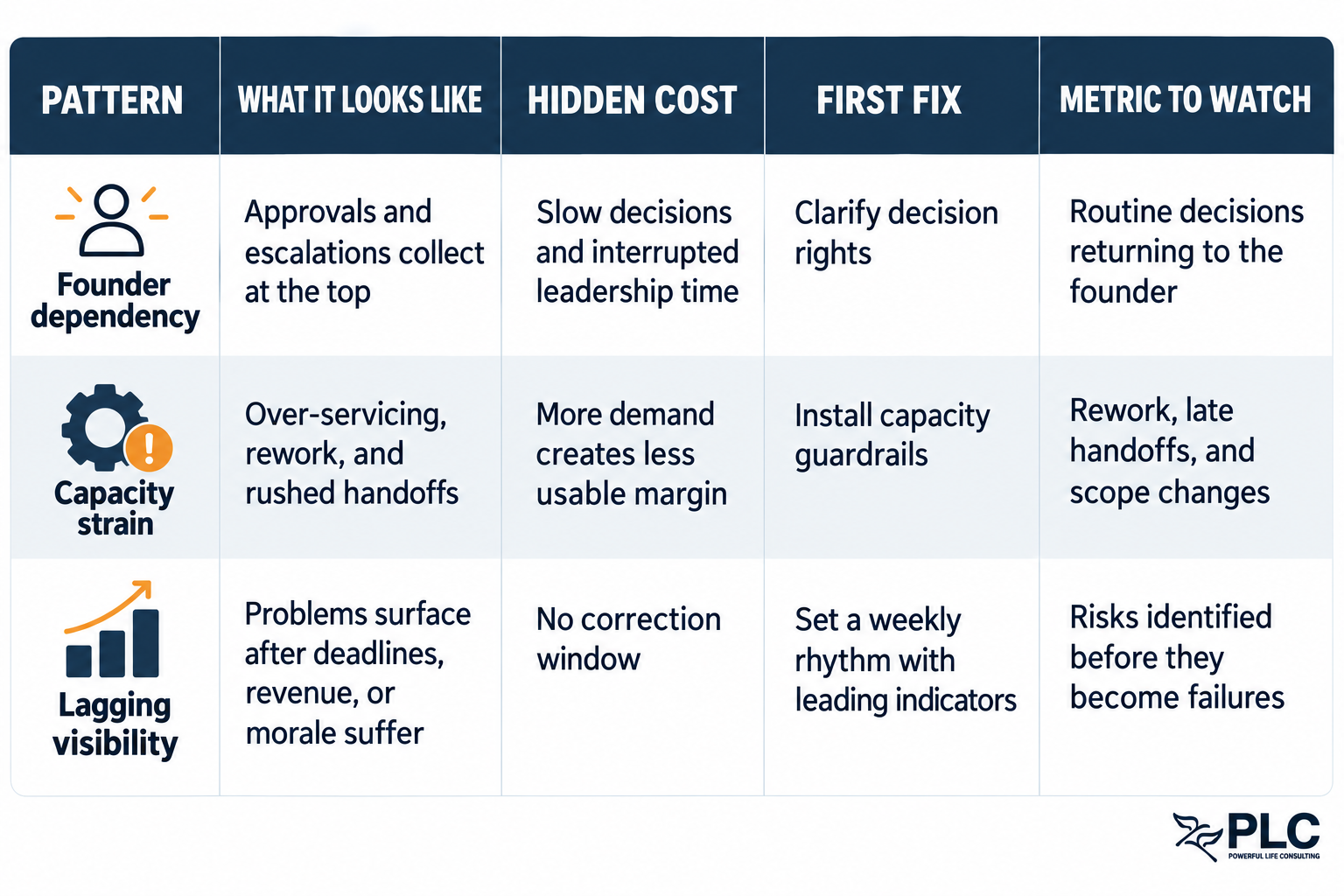
If one of these patterns is already showing up, book a Rapid-Fire Strategy Consultation. We’ll identify the primary growth constraint and map the first 90-day move.
Use This 10-Minute Check to Find the Pattern Creating Your Ceiling
You do not need a full audit to identify the first place to look. Ask these three questions:
- If the founder were unavailable for 2 business days, which decisions would stop?
- If the next ideal client signed tomorrow, where would delivery capacity break first?
- What would we need to know this Friday to prevent next month’s most likely surprise?
Your answers point toward the binding constraint:
- If the first answer produces a long list, start with decision rights.
- If the second answer reveals immediate overload, start with capacity and scope guardrails.
- If the third answer is unclear, start with leading indicators and a weekly operating rhythm.
You can also use the repetition test to distinguish a people issue from a system issue. If different capable people encounter the same failure, the system deserves attention. If no one knows who owns a decision, clarify the structure before blaming execution. If the problem is isolated, clearly owned, and resolved after coaching or a reasonable expectation reset, it may be a people issue.
The point is not to label the business perfectly. The point is to stop treating every symptom as a separate emergency.
What to Fix Before Adding More Demand, Headcount, or Technology
When a service business hits pressure, the instinct is predictable: create more demand, hire more help, or add another platform. Sometimes those moves are necessary. They are rarely the first move when the operating constraint is still unclear.
Use this sequence instead:
- Diagnose the binding constraint. Name the pattern that is limiting decision speed, delivery capacity, or early visibility.
- Stabilize the relevant system. Clarify ownership, set guardrails, or establish the operating rhythm that is missing.
- Measure the change. Watch the few indicators that show whether the constraint is easing.
- Scale from evidence. Add demand, headcount, or technology only when the system can absorb the next level without recreating the same failure.
This is the foundation of scalable growth systems. Sustainable growth is not about squeezing more output from an already stretched team. It is about making the business easier to run as it becomes more valuable.
If the same friction keeps appearing across sales, delivery, and leadership, the next step may be to find the hidden operational constraints rather than launching another isolated fix. The pattern matters because where operational chaos really starts is often earlier and more structural than the visible crisis.
Frequently Asked Questions About Service Business Growth Ceilings
Conclusion: Break the Ceiling by Fixing the Pattern Beneath It
A service business growth ceiling is not a verdict on your ambition. It is a signal that the system supporting growth needs to catch up with the growth already happening.
Start with the pattern you can see most clearly. Clarify the decisions that still depend on the founder. Protect delivery capacity before demand outruns it. Replace lagging explanations with a weekly rhythm that gives the team time to act.
You do not need to rebuild the entire business this week. You do need to stop adding complexity to a constraint you have not named.
If one of these patterns is already showing up, book a Rapid-Fire Strategy Consultation. We’ll identify the primary growth constraint and map the first 90-day move.


