The Business Optimization Audit Every Scaling Service Business Should Run Before Hiring More Help
Scaling should make your business lighter. More capacity. More control. More margin.
But for many 6- to 8-figure service businesses, the opposite happens.
Revenue grows… and so does the pressure. Delivery slows down. Margins tighten. Small issues turn into daily fire drills. And instead of feeling in control, you’re holding more of the business together than ever.
At that point, the instinct is predictable: we need more people.
You probably don’t.
What you actually need is visibility into where your operations are breaking down - and a plan to fix it.
That’s where a business optimization audit comes in.
Why Hiring Too Early Creates More Problems Than It Solves
More people don’t fix broken systems. They expose them.
When processes are unclear, ownership is fuzzy, and information is scattered, every new hire inherits the same confusion - and adds their own variation to it.
The result isn’t leverage. It’s noise.
You’ve likely seen some version of this:
- Projects slow down despite a bigger team
- Clients start escalating issues higher up
- Work gets redone - or worse, missed entirely
- You’re pulled back into decisions you thought you’d delegated
One consulting firm I worked with doubled their delivery team after a growth spike. Within months, the CEO was back in the weeds - rescuing accounts, clarifying expectations, and chasing updates across disconnected systems.
They didn’t have a capacity problem. They had an operational clarity problem. And hiring into that only made it more expensive.
What Growth Is Hiding From You
Revenue can be misleading.
It tells you demand is there - but it says nothing about how efficiently your business is delivering on it.
Under the surface, most scaling service businesses are dealing with:
- Work that gets stuck or quietly dropped
- Processes that rely on memory instead of systems
- CRM data that can’t be trusted
- Reporting that arrives too late to act on
- Teams that are busy - but not aligned
These aren’t isolated issues. They’re signals of friction inside your operations.
A business optimization audit brings that friction into the open - so you can fix it before it compounds.
The 5 Areas Every Business Optimization Audit Must Cover
A real audit isn’t a generic checklist. It’s a focused assessment of how work actually flows through your business.
Start here:
1. Workflow
Are your core processes defined and visible - or does execution depend on who happens to be involved?
If work moves differently every time, you don’t have a process. You have improvisation.
Discover hidden operational inefficiencies in 7-figure businesses.
2. Delivery & Handoffs
Where do projects slow down, stall, or require follow-up?
Handoffs are one of the biggest sources of delay and rework - and one of the least examined.
3. CRM, Lead Flow, and Follow-Up
Can you trust your data?
If leads, conversations, or next steps aren’t consistently tracked, you’re leaking revenue - whether you see it or not.
4. Reporting & Visibility
Are you making decisions from real-time insight - or piecing together last week’s data?
If reporting lags, leadership defaults to guesswork.
5. Capacity, Ownership, and Role Clarity
Does everyone know what they own?
Or does work consistently pile up on the same people - usually your strongest operators… or you?
Learn how to systemize your business with effective SOPs.
A 90-Minute Audit You Can Run This Week
You don’t need a full overhaul to get started.
Block 90 minutes with your leadership team and ask five direct questions:
- Where does work consistently slow down or bounce between people?
- Where have we seen delays, rework, or dropped handoffs in the last 30 days?
- Are leads or clients falling through the cracks? Can we trust our CRM?
- Where are we waiting for data - or making decisions without it?
- Where is ownership unclear or repeatedly escalated?
Listen carefully to the language in the room.
If you hear:
- “We handle that case-by-case”
- “I thought someone else had it”
- “It depends who’s running the project”
You’ve found your bottlenecks.
What to Fix First
Not everything needs to be rebuilt. The goal isn’t perfection - it’s leverage. Start with the issues that:
- Free up leadership time
- Reduce rework or delays
- Improve client delivery consistency
Then separate your actions into two categories:
Quick wins
Small changes with immediate impact - clarifying a handoff, tightening a CRM step, updating a key SOP.
Structural fixes
Deeper changes that create long-term capacity - redesigning workflows, improving reporting cadence, reassigning ownership.
Both matter. But don’t confuse activity with progress.
If a fix doesn’t increase capacity, margin, or clarity, it’s probably not a priority.
Discover the biggest mistakes in business optimization.
When You Need an Outside Perspective
There’s a point where internal fixes stop working - not because your team isn’t capable, but because you’re too close to the system.
If you’re seeing the same issues repeat, or complexity keeps increasing without relief, it’s time to step back. Common signs:
- Problems resurface after every “fix”
- Reporting is fragmented or unreliable
- Your team is busy, but outcomes aren’t improving
- You’re still the default decision-maker
At that stage, the constraint isn’t effort. It’s structure.
An experienced, systems-led perspective can help you identify root causes faster - and build solutions that actually hold under growth.
From Audit to Scale
Hiring should support a strong system - not compensate for a weak one.
Before you add headcount, get clear on how your business is operating today. Because when your systems are working:
- Your team moves faster without constant oversight
- Clients experience consistency at every stage
- Decisions are based on real data, not guesswork
- Growth creates capacity - not pressure
If you want that kind of scale, start with the audit.
Then build from there.
Ready to transform your business?
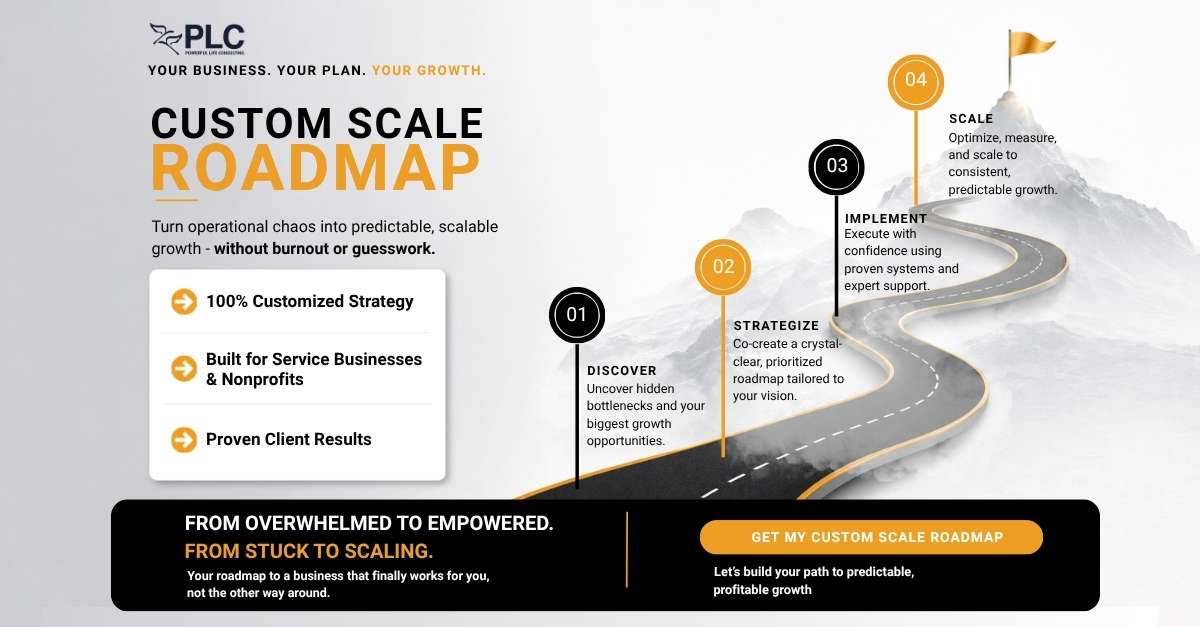
Apply for the Custom Scale Roadmap to build your next stage on clarity, not complexity.